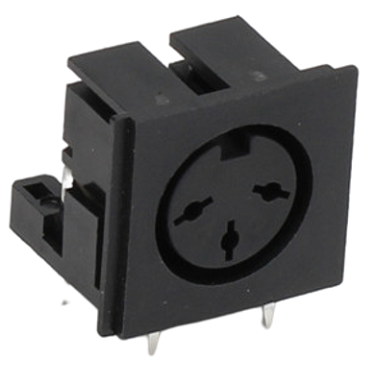
DS connector usage conditions: 1. Rated current: 2A AC 2. Rated voltage: 100V AC 3. Environmental temperature: -25~70 ° C 4. Relative humidity: 95% (40 ° C) 5. Contact resistance: ≤ 30M Ω 6. Insulation resistance: ≥ 100M Ω 7. Voltage resistance: AC500V (50Hz) for 1 minute 8. Insertion and extraction force: 40-100N 9. Lifespan: 5000 cycles 10. Plastic PBT UL-94V0 11. Silver plated brass terminals 12. Brand: Coaster Switch KSDKG 13. Origin: Dongguan, China
1. Definition DS socket (Data&Signal socket) is usually a socket used for data and signal transmission. It is an interface component used to connect devices, with the main purpose of providing a standard and stable connection point for related devices to ensure accurate and error free exchange of data and signals.
2. Appearance structure Diverse shapes: Their shapes may vary depending on specific application scenarios and design standards. Common ones include rectangles and circles. Rectangular DS sockets generally have multiple sockets arranged in a regular pattern, with metal contact points visible on the surface of the socket for connecting to the pins of the plug. The appearance of a circular DS socket is similar to a traditional circular power socket, but the distribution and purpose of the sockets are completely different from those of a power socket. The internal contact structure is designed according to the type of data and signal that needs to be transmitted.
Pin interface: In terms of the number of pins, there are simple DS sockets with as few as a few pins, as well as complex sockets with dozens of pins. These pins are used for different data lines, signal lines, or power lines (in some cases). For example, in some small electronic devices' DS sockets, there may be 4-6 pins used for transmitting data signals, control signals, and grounding. In industrial control equipment or large computer systems, the number of pins in DS sockets may reach 20-30 or even more, and there are strict pin definitions and functional divisions.
Shell material: The shell is generally made of hard plastic or metal. Plastic shells are relatively lightweight, cost-effective, and have certain insulation properties. Metal shell DS sockets are usually used in environments that require high electromagnetic shielding. They can effectively prevent external electromagnetic interference from entering the socket, affecting the transmission of data and signals, and also prevent signals inside the socket from causing electromagnetic interference to the outside.
3. Working principle When the matching DS plug is inserted into the socket, the pins on the plug are tightly connected to the contact points inside the socket. Through these connection points, data can be sent and received between devices. For example, in digital communication systems, data is transmitted in binary form (a sequence of 0s and 1s) through specific pin lines of sockets. The signal can be a control signal, such as the start and stop signals of the device, or a status signal, used to provide feedback on the working status of the device.
If it is transmitting analog signals, the socket plays a role in guiding and stabilizing signal transmission. For example, in the connection of some audio devices, analog audio signals are transmitted from one device (such as a player) to another device (such as an amplifier) through a DS socket. The internal circuit design of the socket can ensure that the signal is attenuated and distorted as little as possible during transmission.
4. Application scenarios Electronic device communication: In mobile electronic devices such as smartphones and tablets, DS sockets can be used for data transmission between devices, such as connecting phones and computers through dedicated data cables for data backup, synchronization, and other operations. This socket ensures fast and accurate data transmission between mobile phones and computers, such as transferring various types of data such as photos, videos, documents, etc.
Industrial control: In automated production lines and industrial control systems, DS sockets are used to connect various controllers, sensors, and actuators. The temperature, pressure, flow and other data collected by sensors are transmitted to the controller through the DS socket. The controller issues instructions based on these data, and then transmits the instructions to actuators such as motors and valves through the DS socket to achieve automation control of industrial production processes.
Consumer electronics connectivity: In home theater systems, DS sockets are used to connect devices such as DVD players, amplifiers, and speakers. It can ensure high-quality transmission of audio and video signals, allowing users to enjoy clear sound and images. For example, a DVD player transmits digital video signals to an amplifier and television through a DS socket, while transmitting audio signals to the amplifier. The amplifier then transmits the amplified audio signals to the speaker through a DS socket.